The Long Bright Land (1929)
Illustrated by Dorothy Lathrop
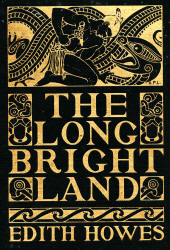 |
To the left, we show a copy of
The Long Bright Land, as illustrated
by Dorothy Lathrop - published by
Little, Brown, and Company (Boston) in 1929.
This example retains the original
decoratively gilt-stamped black
cloth cover.
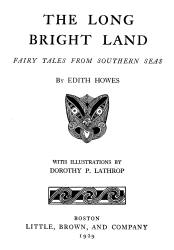
On the right, we show the
decorated
Title Page to The Long Bright
Land. |
 |
The Long Bright Land (1929) is a work
from the New Zealand teacher, author and educationalist, Edith Howes. It
is one of many books she wrote for children and seeks
to contribute to the preservation of Maori history. Howes'
Foreword - shown below - provides some background to
the work and its raison d'être.
Centuries before Columbus braved the Atlantic Ocean and
discovered America those
intrepid navigators, the Maoris, in their
tree-hollowed, compass-less canoes, voyaged
and re-voyaged the Pacific, compared with which the
Atlantic is but a narrow sea.
From their tropic shores (perhaps India or a Pacific
continent since sunken) they
migrated to tropic islands. Still farther they voyaged,
sailing so far south that they
came in sight of ice fields, "a land white like fat";
on their way back they discovered
Ao-tea-roa, "the Long Bright land", which the later
Dutch explorer, Abel Tasman,
called New Zealand.
In successive migrations, about the fourteenth century,
several tribes sought these
lovely islands of the New Zealand group and remained.
They brought with them and
established here their stone-age culture, their
priests, their traditions from the older
lands.
When the first white pioneers and missionaries came a
hundred years ago, they found
a savage but magnificent race, still in the stone age
but possessed of Halls of Learning
in which their youths were taught. Here their age-long
genealogies were handed
down, to be stored in trained and unerring memories.
Here were kept alive those
far-off recollections of the great voyages and of that
loved and long-lost motherland
which had given their viking ancestors birth - that
Hawa-iki to which there was now
no return in life, since the route had somehow been
forgotten, but to which, after
death, sighing spirits took their flight from the
northernmost point of the Long Bright
Land.
Here, too, were preserved the mysteries and the annals
of their religion: magic,
speculations into Nothingness and Darkness and
Beginning and the making of the
world, tales and attributes of their gods and half-gods
- a complicated and highly
poetic mythology, enriched with poems and prayers,
songs and proverbs, folk lore
and fairies.
The early missionaries, and more notably Sire George
Grey, appointed Governor-in-
Chief of New Zealand in 1845, collected and translated
a great mass of these myths,
legends, folk tales, poems, prayers, and proverbs. From
their old books and from
more recent work in the field of Polynesian mythology,
I have culled these tales.
The young Maoris now are brought up in the civilization
of the whites; their
stone-age culture is superseded by that of electricity
and stainless knives; their legends
are forgotten. But that these tales of a race's
childhood, this store of romance and
poetry and laughter should be lost to the childhood of
to-day - would it not be
a pity?
The colour and monotone suite of illustrations prepared
by Lathrop to accompany Howes' work pay a most
wonderful homage to the Polynesian tales and captures -
in dramatic fashion - the themes of the tales.
Our Greeting Cards and Reproduction Prints
|
We have prepared sets of 17 Greeting Cards displaying
each of Lathrop's colour and
monotone illustrations for The Long Bright Land and on the
right, we show an
example of how these Greeting
Cards appear. Ordering one of those sets is as easy
as selecting the "Add to
Cart" feature below and following the prompts provided
with our Shopping Cart
secured through PayPal. Multiple purchases will
be
consolidated by that feature and shipping and handling
costs to any destination in
the world are accommodated by our flat-rate fee of US$20 for every
US$200
worth of purchases.
Code: DL
TLBL MS(17)
Price: US$65.00
|
%20(sample).jpg) |
When presented on Greeting Cards, these
images are prepared as tipped-on
plates - in hommage to the hand-crafted
approach typical
of prestige illustrated publications produced in the early decades
of the 20th Century.
Hand-finishing is used to replicate the
visual appearance of a tipped-on plate and the images are presented
on
Ivory card stock (in the case of colour illustrations) or White
card stock (in the case of monotone illustrations)
with an accompanying envelope. We have left the cards blank so that you may write your own personal
message.
Should you wish to order a Reproduction Print of one or more of these images, we have provided some options
below. Of course, should you wish to
discuss some customised options, we welcome
your contact on any matter
through
ThePeople@SpiritoftheAges.com.
In the meantime, enjoy perusing these wonderful
examples of the art of Dorothy Lathop.
The colour illustration
.jpg) |
|
|
|
|
Frontispiece
Inch by inch Maui pulled in the
line,
chanting and pulling, pulling
and
chanting.
|
|
|
|
|
Reproduction on 12x18" sheet
Code: DL TLBL C1 12x18
Price: US$60.00
|
|
|
|
The major monotone illustrations
.jpg) |
.jpg) |
.jpg) |
.jpg) |
|
Cover
|
Title Page |
Contents Page |
Illustrations Page |
|
Reproduction on 12x18" sheet
Code: DL TLBL M1 12x18
Price: US$60.00
|
Reproduction on 12x18" sheet
Code: DL TLBL M2 12x18
Price: US$60.00
|
Reproduction on 12x18" sheet
Code: DL TLBL M3 12x18
Price: US$60.00
|
Reproduction on 12x18" sheet
Code: DL TLBL M4 12x18
Price: US$60.00
|
.jpg) |
.jpg) |
.jpg) |
.jpg) |
|
Matariki's Star
Down into the lake he shot, he
and his star together. |
Maui's Boyhood
In a cluster of seaweeds and
jellyfishes lay Maui, the
little baby. |
Maui and the Dragon
Out the dragon came, swimming
fast toward her. |
The Underworld
"She passed," they told him,
"weeping as she went." |
|
Reproduction on 12x18" sheet
Code: DL TLBL M5 12x18
Price: US$60.00
|
Reproduction on 12x18" sheet
Code: DL TLBL M6 12x18
Price: US$60.00
|
Reproduction on 12x18" sheet
Code: DL TLBL M7 12x18
Price: US$60.00
|
Reproduction on 12x18" sheet
Code: DL TLBL M8 12x18
Price: US$60.00
|
.jpg) |
.jpg) |
.jpg) |
.jpg) |
|
Maid of the Mist
She came forth from the house,
her
long hair about her like a
cloak. |
Rata's Search
Rata and his warriors bade their
people farewell, seated
themselves
in the canoe, and rowed away. |
The Goblin of the Mountains
The Sun's rays struck full on
the
goblin's eyes, dazzling him. |
The Goblin of the Mountains
The warrior stood on the fish's
back and was carried across the
sea to the land of Pou. |
|
Reproduction on 12x18" sheet
Code: DL TLBL M9 12x18
Price: US$60.00
|
Reproduction on 12x18" sheet
Code: DL TLBL M10 12x18
Price: US$60.00
|
Reproduction on 12x18" sheet
Code: DL TLBL M11 12x18
Price: US$60.00
|
Reproduction on 12x18" sheet
Code: DL TLBL M12 12x18
Price: US$60.00
|
.jpg) |
.jpg) |
.jpg) |
.jpg) |
|
The Fireless Island
Down he came swiftly, shaking
the
earth with his weight, and
Manini
had to fly like the wind before
him. |
Hinemoa
The dragon of the deep pushed a
cluster of rocks above the
water,
that Hinemoa might rest on them. |
The Real Princess
So each night Ruru sat with the
real Roronga in her house. |
The Youngest Brother
Now he began to be happy. He
lived by himself in the forest. |
|
Reproduction on 12x18" sheet
Code: DL TLBL M13 12x18
Price: US$60.00
|
Reproduction on 12x18" sheet
Code: DL TLBL M14 12x18
Price: US$60.00
|
Reproduction on 12x18" sheet
Code: DL TLBL M15 12x18
Price: US$60.00
|
Reproduction on 12x18" sheet
Code: DL TLBL M16 12x18
Price: US$60.00
|
