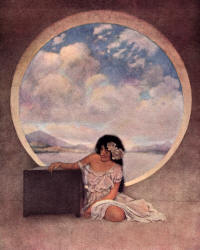
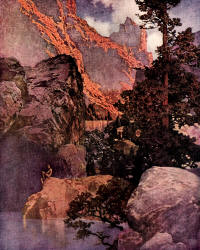
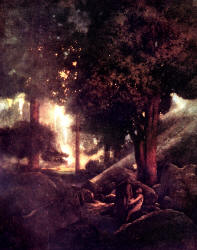
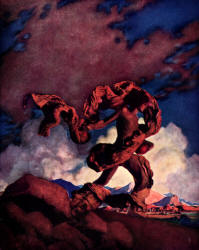
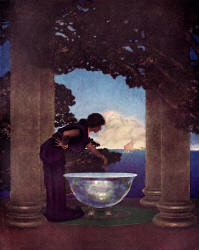
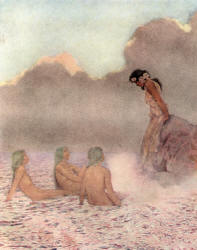
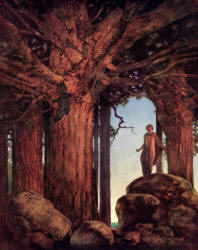
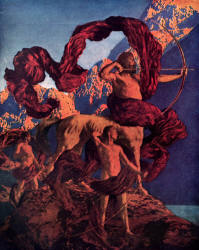
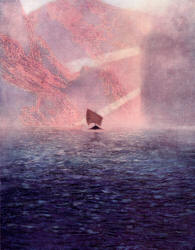
Tanglewood Tales, as illustrated by Maxfield Parrish and
published by
Duffield & Company (New York) in 1910.
This example retains the original
blue cloth cover with
applied illustrated paste-down.
On the right, we show the
illustrated
Title
Page to this 1st Edition.
A Wonder Book and Tanglewood Tales (1910) is the 1st Edition of
Nathaniel Hawthorne's classic tales of Greek myth and
legend that is illustrated by Maxfield Parrish.
In his Preface,
Hawthorne provides an introduction to the history of the
tales that, in this 1st Edition, include:
"The Gorgon's Head"; "The Golden Touch"; "The Paradise
of Children"; "The Three Golden Apples"; "The Miraculous
Pitcher"; "The Chimæra"; "The Wayside"; "The Minotaur";
"The Pygmies"; "The Dragon's Teeth"; "Circe's Palace";
"The Pomegranate Seeds"; and "The Golden Fleece".
Parrish's illustrations are striking, adding his own
visual interpretation to theses classic myths.
Our Greeting Cards and Reproduction Prints
We have prepared sets of 10 Greeting Cards displaying
each of the major colour images from A Wonder Book and Tanglewood Tales (1910) and on the left, we show an example of how these Greeting
Cards appear. Ordering one of those sets is as easy as selecting the "Add to
Cart" feature below and following the prompts provided with our Shopping Cart
secured through PayPal. Multiple purchases will
be consolidated by that feature and shipping and handling costs to any destination in the world are accommodated by our flat-rate fee of US$20 for every
US$200 worth of purchases.
Code: MP
WBTT MS(10) Price: US$50.00
When presented on Greeting Cards, these
images are prepared as tipped-on
plates - in hommage to the hand-crafted
approach typical
of prestige illustrated publications produced in the early decades
of the 20th Century.
Hand-finishing is used to replicate the
visual appearance of a tipped-on plate and the images are presented
on
Ivory card stock (in the case of colour illustrations) or White
card stock (in the case of monotone illustrations)
with an accompanying envelope. We have left the cards blank so that you may write your own personal
message.
Should you wish to order a Reproduction Print or an
individual Greeting Card from this suite of images, we have
provided options below. Of course, should you require a customised preparation, we welcome
your contact through
.jpg)
.jpg)
%20(sample).jpg)