|
|
Illustrated by Jean de Bosschère
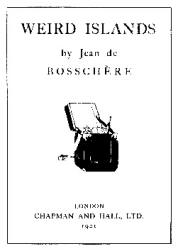
Weird Islands (1921) is a novel written and illustrated by Jean de Bosschère.
The Foreword to the tale by Jean de Bosschère provides a lovely introduction to the story and his personal approach to writing and illustrating Weird Islands. Given his innovative approach to the tale, it is little wonder that Weird Islands was greeted with contemporary critical acclaim as noted in The Burlington Magazine (1921) thus:
The pictures by Jean de Bosschère in Weird Islands, 12s. 6d. (Chapman & Hall), will appeal to more children than those of any of the other books.
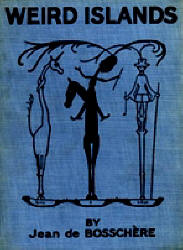
Jean de Bosschère's suite of illustrations to accompany his words for Weird Islands include the full colour frontispiece, in addition to 44 full-page monotone plates and a large number of monotone marginal illustrations.
Our Greeting Cards and Reproduction Images
When presented on Greeting Cards, these images are prepared as tipped-in plates - in hommage to the hand-crafted approach typical of prestige illustrated publications produced in the early decades of the 20th Century. Each card is hand-finished and and the images are presented on White card stock with an accompanying envelope. The rear of each card carries information about Jean de Bosschère, this wonderful suite and the profiled illustration - we have left the interior of the cards blank so that you may write your own personal message.
Should you wish to order a Reproduction Print of one or more of these images, we have provided some options below. Each of these large format prints is also accompanied by information about Jean de Bosschère, this suite and the profiled illustration.
To purchase, simply click on the appropriate "Add to Cart" button and you will be taken through to our Shopping Cart secured through PayPal. Multiple purchases will be consolidated by that feature and shipping and handling costs to any destination in the world are accommodated by our flat-rate fee of US$20 for every US$200 worth of purchases.
Of course, should you wish to discuss some customised options, we welcome your contact on any matter through ThePeople@SpiritoftheAges.com.
In the meantime, enjoy perusing these images from Jean de Bosschère.
The colour frontispiece
The full-page monotone illustrations
Jean de Bosschère's Foreword for Weird Islands
I heard this fantastic story for the first time on a summer evening, and I wish to share at once the pleasure that it gave me with others, of all ages and of all tastes. I must confess, though, that when I had once begun re-telling it, I thought more of the pleasure that it was giving myself than of the pleasure that it would give to others. But we al know that the joy we take in contemplating any work of art must be measured by the joy that went to the artist's creation of it. And certainly the Weird Islands has given me long weeks of genuine happiness. I wish it could have been there to help me while I worked, and while my friend improvised on his violin tunes as curious as Stravinsky's, and while my little green parrakeets nibbled at my brushes.
In re-telling these adventures, I did not adopt the form of a novel, because in that shape it would have taken six volumes to describe Weird Islands, and because I was able to employ another means of description - drawing, which can show immediately people and objects in a way that it would take several pages to describe. Until to-day, no one has attempted to combine these two mediums in a precise and absolute manner. This is not a book in which the drawings repeat and illustrate what the text has told. Here, the author, when it seemed more suitable for the story, has described characters and objects by a drawing; reserving writing to convey impressions, sentiments, anger, melancholy, sadness, surprise and joy or the impatience of the people concerned. And thus the adventures and scenes are told by the drawings as much by the text. Each is the complement of the other. That is the real character of these stories. Weird Islands was never conceived without the drawings.
I know that this method would not suit a novel, where the main interest lies in the development of characters and incident. But it is as natural as it is amusing in a story where the scenes are constantly changing, and where the interest is found particularly in what the queer people, at every step, meet in the way of unexpected creatures and objects, fabulous islands, conciliating and wicked monsters, and creatures who are comic or poetical. I had to show the ten travellers whose voyage had been recounted to me, to show their costumes, their faces, their weapons, and their musical instruments. And so I drew ten faithful portraits (since psychology was not concerned, nor symbolism, nor allegory, nor philosophy). When one of the people met a strange animal, or the Silent Island, or the Island of Long Women, or cannibals, or the building Cyclops, I have made drawings of these creatures instead of giving a long description of them.
It is a legitimate method. Can we not imagine Æsop telling his fables with drawings as well as words; Apuleius tracing on his tablets images of his metamorphoses; Maundeville recounting his voyages with manuscripts covered with sketches. The interest invoked by such a book is not easily exhausted. It is not necessary to read it again to derive pleasure from it. It is enough to turn the pages; the images impress themselves on the memory. Weird Islands, is not, of course, perfect of its kind, perfect that is in comparison with what it might be, with the ideal book which would by like a familiar room, full of souvenirs, curious and strange and tender. Souvenirs and portraits that one could look at and touch at leisure; souvenirs and portraits that, touched or looked upon, would evoke memories of emotions, pleasures and curiosities; souvenirs and portraits which each time one saw them would reveal their mystery a little more.
| ||||||||||||||||||||||||||||||||||||||||||||||||||||||||||||||||||||||||||||||||||||||||||||||||||||||||||||||||||||||||||||||||||||||||||||||||||||||||||||
|