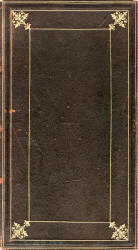
To the left, we show this example's
non-contemporary, but antique,
binding with leather cover.
On the right is shown the title page from
Der Todten-Tantz (1796) published by
Gebrüden von Mechel (Basel).
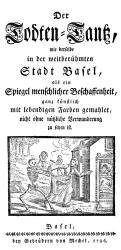
Der Todten-Tantz
The Dance of Death
Illustrated by Georg Scharffenberg and others
|
|
To the left, we show this example's non-contemporary, but antique, binding with leather cover.
On the right is shown the title page from Der Todten-Tantz (1796) published by Gebrüden von Mechel (Basel). |
|
Der Todten-Tantz - translated as The Dance of Death (English) - including the illustrations of Georg Scharffenberg
was a variation on a theme extending from the Medieval World and remaining popular throughout the
Renaissance that followed into the present day.
The premise for the theme is simple enough and one that is undoubtedly just as relevant in the current times as
it was throughout Europe during the Middle Ages, namely, the ever present specter of Death and the exploration
of its role in moving people from this life to the next.
Following the masterful interpretation of the concept by Hans Holbein the Younger - his variant on the theme
was published in 1538 - other artists turned their talents to producing suites of illustrations for print, including
Scharffenberg (who prepared his illustrations in, or about 1576). The suite of illustrations from Scharffenberg and
his fellow collaborators survives in the form of Der Todten-Tantz in which the wonderful illustrations are purported
to be linked with the surviving text from the Medieval "Dance of Death" mural formerly located in one of Basle's
Medieval churches (fragments of this mural can be seen today in Basle's Historical Museum [Historisches Museum
Basel]).
It appears that the work of Scharffenberg and his fellow collaborators may have been originally prepared from
the "Dance of Death" mural known to have been installed at the Dominican Convent in Basle. That attribution is
drawn from the plate appearing within this suite of illustrations that reproduces the memorial dedication to the
family of Hank Klauber and Barbara Hallerin that is known to have been added to the the Basle mural during its
restoration some time after 1568. Klauber - reputedly an eminent painter at the time - was commissioned to
undertake restoration work on the mural, in addition to adding a scene depicting Oecolampadius preaching in
hommage to the recent Reformation. During that restoration activity, Klauber added depictions of himself, his
wife and his son - in a style similar to the other elements of the mural (that image has subsequently become
associated with the text identified as "Der Mahler").
In addition to Scharffenberg's monogram ("GS" and the associated stylised woodcutter's knife), other artists
contributing to the memorial work - later to become associated with Basle's Der Todten-Tantz - are identified
by the following monograms appearing within the suite: "D.R."; and "K". The monogram "D.R." is noted by
Bartsch.
As published by the Mechel brothers, Die Todten-Tantz is a souvenir, of sorts, of Basle's medieval "Dance of Death"
mural which, is promoted with the following words:
The Dance of Death, painted most skillfully, and in lively colours, in the very famous town
of Basel, as a mirror of human life, and not to be looked at without admiration.
Many of the illustrations from Scharffenberg and his other collaborators are more appropriately linked with the
traditional text associated with the suite of woodcuts produced by Holbein, and it is that text that we have associated,
where appropriate, with each image from this suite highlighted within the Collection.
Some commentators have suggested that the illustrations produced by Scharffenberg and his co-contributors may
be viewed as blending a variety of styles and themes pursued by other artists, including Holbein and Jobst Amman.
In doing so, the illustrations bridge the gap between the earlier Medieval vision of Death as a malevolent interfering
character and Holbein's attempts to reform the perception of Death to one of a willing guide for the travelling Soul.
Thus, in Scharffenberg's version of 'The Blind Man', for example, Death is shown leading the Man by his cane (in the
spirit of Holbein's work), in addition to actively cutting the leash to the guide dog with scissors (a reflection on the
earlier Medieval tradition). In taking this approach, to some degree, Scharffenberg is inviting the viewer to consider
the merits of an artistic counter- reformation - a fitting journey considering the time in which he lived.
Such a critique appears to have some merit, but it is also worth considering the reported comments of visitors to
Basel, including Blainville, who wrote about the Dominican "Dance of Death". Douce (1833) described Blainville's
detailed comment made after he viewed the mural in 1707:
He particularizes two of the most remarkable subject, namely, the fat jolly cook, whom Death
seizes by the hand, carrying on his shoulder a spit with a capon ready larded, which he looks
upon with a wishful eye, as if he regretted being obliged to set out before it was quite roasted.
The other figure is that of the blind beggar led by his dog, whom Death snaps up with one hand,
and with the other cuts the string by which the dog was tied to his master's arm.
Given the reported comments of Blainville, the suite of images published by the Mechel brothers may deserve
recognition as a record of the great mural in its own right.
Our Greeting Cards and Reproduction Prints
%20(sample).jpg) |
For connoisseurs, we have prepared sets of 41 Greeting Cards displaying each of the images from Der Todten-Tantz and on the left, we show an example of how these Greeting Cards appear. Ordering one of those sets is as easy as selecting the "Add to Cart" feature below and following the prompts provided with our Shopping Cart secured through PayPal. Multiple purchases will be consolidated by that feature and shipping and handling costs to any destination in the world are accommodated by our flat-rate fee of US$20 for every US$200 worth of purchases.
Code: GS
TT MS(41) |
When presented on Greeting Cards, these images are prepared as tipped-on plates - in hommage to the hand-crafted
approach typical of prestige illustrated publications produced in the early decades of the 20th Century. Each card is
hand-finished and the images are presented on White card stock with an accompanying envelope. On the rear of each
card we also present some information about this great work and each individual illustration. We have left the interior
of the cards blank so that you may write your own personal message.
Should you wish to order a Reproduction Print or an individual Greeting Card from this suite, or simply like to read
more about any of the images in this superb set, please follow the hyperlinks (that is, click on the illustration of
interest) and you will be taken through to a page dedicated to that illustration. Of course, should you wish to discuss
some customised options, we welcome your contact on any matter through ThePeople@SpiritoftheAges.com.
In the meantime, enjoy perusing these powerful images from the suite published as Der Todten-Tantz including
designs by Scharffenberg and his fellow collaborators.
The plates from Der Todten-Tantz
.jpg) |
.jpg) |
.jpg) |
.jpg) |
|
(The Preacher) Plate 1
|
(The Last Judgment) Plate 2 |
(The Pope) Plate 3 |
(The Emperor) Plate 4 |
.jpg) |
.jpg) |
.jpg) |
.jpg) |
|
(The Empress) Plate 5
|
(The King) Plate 6 |
(The Queen) Plate 7 |
(The Cardinal) Plate 8 |
.jpg) |
.jpg) |
.jpg) |
.jpg) |
|
(The Bishop) Plate 9
|
(The Duke) Plate 10 |
(The Knight) Plate 11 |
(The Abbot) Plate 12 |
.jpg) |
.jpg) |
.jpg) |
.jpg) |
|
(The Nobleman) Plate 13
|
(The Noblewoman) Plate 14 |
(The Advocate) Plate 15 |
(The Councilor) Plate 16 |
.jpg) |
.jpg) |
.jpg) |
.jpg) |
|
(The Canon) Plate 17
|
(The Physician) Plate 18 |
(The Merchant) Plate 19 |
(The Abbess) Plate 20 |
.jpg) |
.jpg) |
.jpg) |
.jpg) |
|
(The Hermit) Plate 21
|
(The Young Man) Plate 22 |
(The Maiden) Plate 23 |
(The Usurer) Plate 24 |
.jpg) |
.jpg) |
.jpg) |
.jpg) |
|
(The Piper) Plate 25
|
(The Judge) Plate 26 |
(The Fool) Plate 27 |
(The Pedlar) Plate 28 |
.jpg) |
.jpg) |
.jpg) |
.jpg) |
|
(The Blind Man) Plate 29
|
(The Jew) Plate 30 |
(The Heathen) Plate 31 |
(The Heathen's Wife) Plate 32 |
.jpg) |
.jpg) |
.jpg) |
.jpg) |
|
(The Cook) Plate 33
|
(The Farmer) Plate 34 |
(The Child) Plate 35 |
(The Painter) Plate 36 |
.jpg) |
.jpg) |
.jpg) |
.jpg) |
|
(The Drunkard) Plate 37
|
(The Gambler) Plate 38 |
(The Robber) Plate 39 |
(The Temptation and Fall) Plate 40 |
.jpg) |
|||
|
(The Expulsion) Plate 41
|
